
DMS G-Comp is an audio plugin in VST3* format for Windows 8 and above or in both VST3* and AU** formats on Mac OS 10.11 and above. It is a high quality compressor with a built in noise gate. It also has a resizable user interface. DMS G-Comp can optionally use a side-chain input if one is available on the channel/track that it is on. While no particular hardware unit was disassembled, analyzed, or modeled in the development of this plugin, you will find that certain settings of DMS G-Comp will produce very authentic sounding results. DMS G-Comp was designed to be used with a guitar along with your favorite amp simulation plugin, but also sounds great with other instruments. Like all other plugins made by DMS Plugins, DMS G-Comp will be a valuable asset in your arsenal of audio tools.
* VST and VST3 are trademarks of Steinberg Media Technologies GmbH.
** The Audio Units logo is a trademark of Apple Computer, Inc.
Controls
DMS G-Comp’s user interface contains knobs, buttons, switches, menus, and a parameter value display control. The value of a knob can be adjusted by clicking on it and dragging your mouse vertically. Double clicking a knob will reset it to its default value. Holding your Shift key while click/dragging a knob will allow you to more precisely adjust its value. For even more precise control, click on the right hand side of the value display control and enter a new value. In the case of controls with discrete values, clicking on the value display control will bring up a menu.

• Preset increment/ decrement buttons – The red triangle shaped buttons at the top of the UI on either side of the preset menu change the currently selected preset by one. The button on the left selects the previous preset. The one on the right selects the next preset.
• Preset menu – DMS G-Comp comes with 15 factory presets. The preset menu is used to select, rename, or create new presets. See Preset Management for detailed information.
• Info button – Opens an “about page” that contains basic information about the plugin. When the information page is open, clicking on the DMS Plugins logo will take you to the DMS Plugins website. Clicking anywhere else on the information page will close it.
• Parameter Value display – Displays the name and value of the last touched control. It also can be used to edit the currently displayed value.
• Preset file menu – Clicking on the folder shaped icon to the right of the parameter value display opens a menu for preset management/ file operations. See Preset Management for detailed information.

• Meters – There are 3 level meters on the user interface, one on the left side and two on the right. The source level meter is on the far left. It displays the signal used to determine the compressor’s behavior. It is also the input signal unless one of the side-chain inputs are selected as a source. On the right hand side of the UI are the 2 remaining meters. The one on the left is the input level meter and the one on the right is the output level meter.
• Resizing handle – Hovering your cursor over the bottom-right corner of the plugin will expose a triangle that when clicked and dragged, will enlarge or reduce the plugin’s size.
• Comp/Gate switch – This toggle switch changes the plugin’s view between the compressor view and noise gate view.
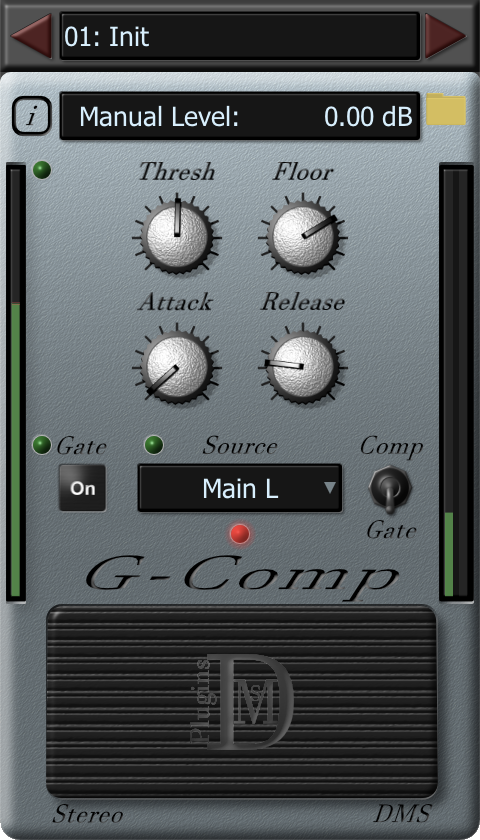
Gate View Controls
• Thresh – The level in dB that the input signal must be greater than in order to open the noise gate or be lower than to close it. The green bar on the input level meter graphically represents the gate threshold level.
• Floor – Adjusts the amount of signal allowed through the noise gate when it is closed.
• Attack –The time in ms that it takes to open the noise gate.
• Release –The time in ms that it takes to close the noise gate.
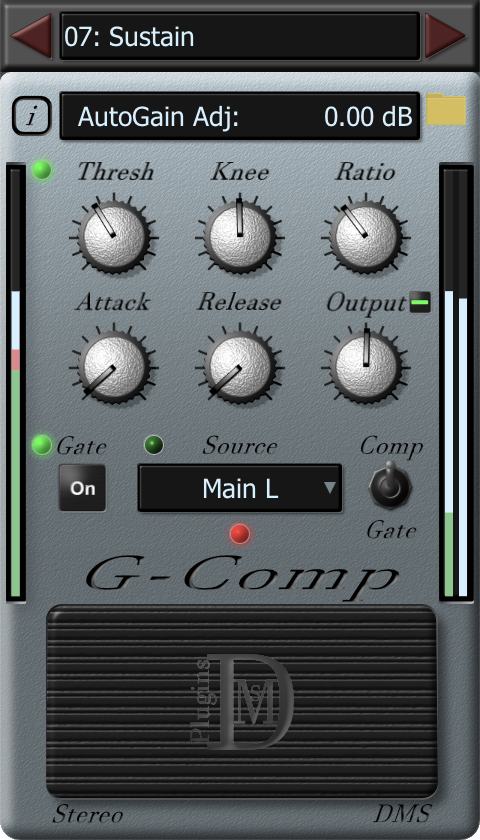
Compressor View Controls
• Thresh –The level in dB that the source signal must be greater than in order to start compressing the input signal or be lower than to stop. The green bar on the source level meter graphically represents the compressor threshold level.
• Knee – A range in dB below the threshold to gradually start compression before reaching the threshold. The red bar on the source level meter graphically represents the knee.
• Ratio – A ratio of input level to output level to express the amount of compression applied after a signal exceeds the threshold.
• Attack – The time in ms it takes to compress the signal. Slowing the attack time allows transients to get through for a punchier sound.

• Release – The time in ms it takes to stop compressing.
• Output – Adjusts the output level to compensate for gain reduction caused by compression. When the auto-gain switch is enabled,
• AutoGain Switch– Automatically adjusts the output level to compensate for gain reduction caused by compression.
• Gate Switch – Turns the noise gate on and off.
• Source – A menu from which you can select the audio source used to determine the compressor’s behavior.
• Bypass – A switch that causes a whisper quiet transition to and from bypass.
Requirements
- Windows 8 (64 bit) or later
- macOS 10.11 or later
- VST compatible host software on both Mac and Windows
- Audio Units compatible host on Mac
